Saturday, September 13, 2008

Deadlines and deadlines: Why making them is important

SACRAMENTO, Calif., USA - The beginning of every semester brings a new crop of students, many of whom have never faced the absolute deadlines that exist in most journalistic writing.

Whether it is something as simple as sending me an email (so I can create an email list for the class) or turning in a column or other piece of writing, there are always a few students who don't make the deadline.

And then there is always the argument that the deadline is arbitrary and not grounded in any real need.

Sigh.
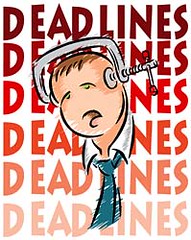
Deadlines

My first newspaper job was at the Napa Register, in the circulation department where I pulled stacks of paper off the press and got them ready for delivery to the paper carriers all over Napa and Solano County. The press was supposed to start at 1 p.m. Not 12:59 (though going early would have been ok), but 1 p.m.

If the press was more than a minute or two starting up, the phone in the press room would start ringing and within 10 minutes or so, all the department heads in the building involved in the production of the newspaper would be in the publisher's office, getting their asses chewed - quite thoroughly - by publisher J.V. Brenner as he would try to figure out where the fault was.

When I moved into the newsroom a year later, as a novice reporter, I found out that if I was five minutes late with a story, it would likely result in my editor being late in what he turned into the composing room which in turn meant composing would be late to the plate-making department (for the press) and so on.

A story that was five minutes late could cause a domino effect that could make the presses a half-hour late.

I never missed a deadline there.

At the Sacramento Bee, when I worked as fill-in editor for the Forum section, the pages were to be sent electronically to composing by 5 p.m. on Thursdays. And if they didn't show up in the queue by 5:01, the phone would start ringing in then-editor Bill Moore's office where I worked, the secretary would come bustling in with a message from downstairs and within a few minutes after than, the big boss, Howard Weaver, was likely to start asking me 'What-the-hell-is-goin'-on?'

There are reasons, of course, why sometimes things don't get written - and turned in - on time.

Sickness, computer malfunctions, balky sources and plain old writer's block can all push the writer past that magic time.

None of them (except perhaps sickness) ever gets the writer any slack from an editor. Deadlines are deadlines - including showing up on time.

At the Petaluma Argus-Courier, we had one writer who was 15 minutes late arriving at work every morning. You could, as the expression goes, set your watch by his arrival.

When I became his editor after about a year, I asked him why he was routinely late every morning. He said he just didn't know. He left in what he thought was plenty of time - even driving faster than the speed limit most of the way from San Rafael to Petaluma.

But he was always 15 minutes late.

I suggested another strategy that he had apparently never thought of: leave his house 15 minutes earlier every morning.

You can guess what happened when he did start leaving his house earlier.

When I have a piece of writing to do - any writing - I estimate how long it will take me to get it done, and then I double the estimate, starting waaaaay earlier than I think I need to.

That system works well enough that I haven't missed a deadline since, well, I can't remember ever missing a deadline for turning in a story to magazine, newspaper, or web-based publication.

That day might come, I suppose, but for now I have to close off this blog entry. I gave myself an 11:50 deadline to get this done.

And I don't want to be late.

Thursday, September 11, 2008

Column writers tackle rules that make no sense

SACRAMENTO, Calif., USA - My assignment to the column writers this week was to craft a column around the idea of rules - rules that seem nonsensical or weird or maybe even that do the opposite of what they were intended to do.

Of course, it is also possible to write about rules for which their reason for existing has evaporated into the mists of the past.

You don't have to think too hard to come up with those.

One strict rule I remember from growing up was that if I ate anything - a single potato chip - I was not allowed to go swimming for 45 minutes. Why? Well, because if I did, I would absolutely get a cramp and sink like a stone. At least that's what my mother and and grandmother and aunts and uncles said - and enforced on me and my cousins.

Since then, I found that the time varied greatly among people and their families. Some parents told their kids it was an hour, others a half-hour. When I became lifeguard in college, I discovered that the whole concept was mostly bull**it. You would have to eat a double-cheese burger and wash it down with a Big Gulp before there's a chance (a chance!) of any cramping.

More likely even in that case, you would only cut loose with a burp that could knock a sleeping lifeguard right off their chair.

That said, I did once have to swim out to rescue a soldier on leave who got a stomach cramp and did sink like a stone into 15 feet of water. But he hadn't had anything to eat or drink for several hours.

Rules, rules, rules. I should get to read some very interesting columns Friday morning.

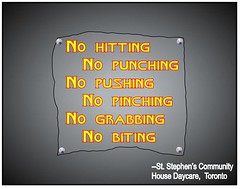
Daycare rules

Monday, September 08, 2008

Back to the twin pursuits of columns and literary journalism

CALIFORNIA STATE UNIVERSITY, Sacramento, Sacramento, CA USA - With two heavy duty writing classes on my schedule this semester - Literary Journalism and Column Writing - it would seem that I should get inspired to get back to my own writing.

Perhaps.

Moving into a new house, after flying 2,500 miles to get here, took most of the writing starch out of me with this missive being the first writing since leaving Valois, New York more than a week ago.

Que lastima.

But these two classes (and two basic news writing courses) almost always provide a kind of weird kinetic vibration that gets me writing again after short respites.

In Literary Journalism, we will be reading the works of Sebastian Junger, Hunter S. Thompson, Jon Krakauer and a half dozen others. The students will also be producing a draft of a major piece of Literary Journalism, after a semester of research.

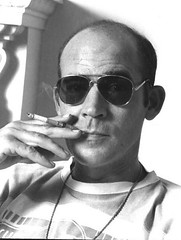
Hunter S. Thompson, R.I.P
Hunter S. Thompson

In column writing, students will be producing two 650-word columns per week - an admittedly heavy load - except that the work is, well, the work of writing and by the end of the semester they should be, for the most part, facil writers who can bang out a column.

And me? I'll be reading a lot of student work, but also getting back to work on my fiction (Soundtrack, a novel that has been in progress for five years) and beginning a work of literary journalism about immigration. I say beginning because my best sources are in Mexico, a few houses from where I will be living this winter and spring.

And, time permitting, I'll be back using this column to talk about making money with writing.

Time permitting.

Brass clock

Tuesday, December 11, 2007

Closing out Column Writing class for the semester

CSU, SACRAMENTO, Sacramento, Calif. USA - The same technology that makes it possible for anyone with computer access to be a publisher (you are looking at it...) helped this semester to make my column writing class arguably the most successful ever.

It was successful because the students were able to write a column or two per week and post them for the entire class (and the world, via the Internet) to see.

From my end of the telescope, it created a nightmare of reading. Most weeks they had to write two columns, one assigned, the other on an area of specialization. But for them the practice was invaluable and the growth as writers was dramatic in a very short time.

I also learned a lot during the semester as these student-columnists wrote about nutrition, politics, cars, life at the mall, television and a dozen other areas. One young lady from Ireland (if she is from Ireland should I say young lass?) wrote about religion and did a fine job explaining different faiths in a humorous way that frequently had me laughing aloud.

But one column she penned about YouTube had the following paragraph, which, like several pieces written by other students, made me laugh so hard I sprayed my computer screen with remants of the Earl Grey tea I was sipping while reading.

"To summarize, if we were to take YouTube as a source we find that French people are apparently perverted, food loving, hotties, the Dutch enjoy nothing better than grabbing their tulips, the Irish are alcoholics with horrendous taste in music, the British are prudes and the Japanese are gadget-loving oddballs and, of course,
every nation has an unhealthy obsession with sex. No surprises there then."


The class gathered one last time on campus Monday night. It wasn't the Algonquin Roundtable - not yet. But with these writers, it might be someday.

Monday, December 03, 2007

Lisa Heyamoto talks about column writing with J-class

SACRAMENTO, Calif., USA - The Sacramento Bee's newest three dot columnist came by my column writing class Monday night to share her insights into the column-writing bizz.

Bouncy and upbeat as always, Lisa Heyamoto managed to infect the room - even though most of the students are suffering from end-of-the-semester fatigue and near burn out.

She was as candid as candid can be in answering questions about where she gets her ideas, how she puts together her three-times-per-week column and how it is to work with various editors, either at The Bee or in Seattle where she worked before moving the California.

At 29, she is the youngest of all The Bee's columnists - by a factor of probably 25 years.
  • Lisa's column

  • She provided some serious inspiration for some of the students who have been reading all the doom and gloom about the newspaper and publishing industries. Work hard, she said, and take whatever job you need to get that foot in the door.

    Very wise words.

    Here's a brief clip of Lisa speaking to class.